3D Controls Showcases Industrial Ceramic 3D Printing Production at ‘INTRA 2026’
- Exhibition of nozzles, filters, etc., and discussions on collaboration with demand companies in semiconductor, electronics, and automotive sectors
2026-10-06
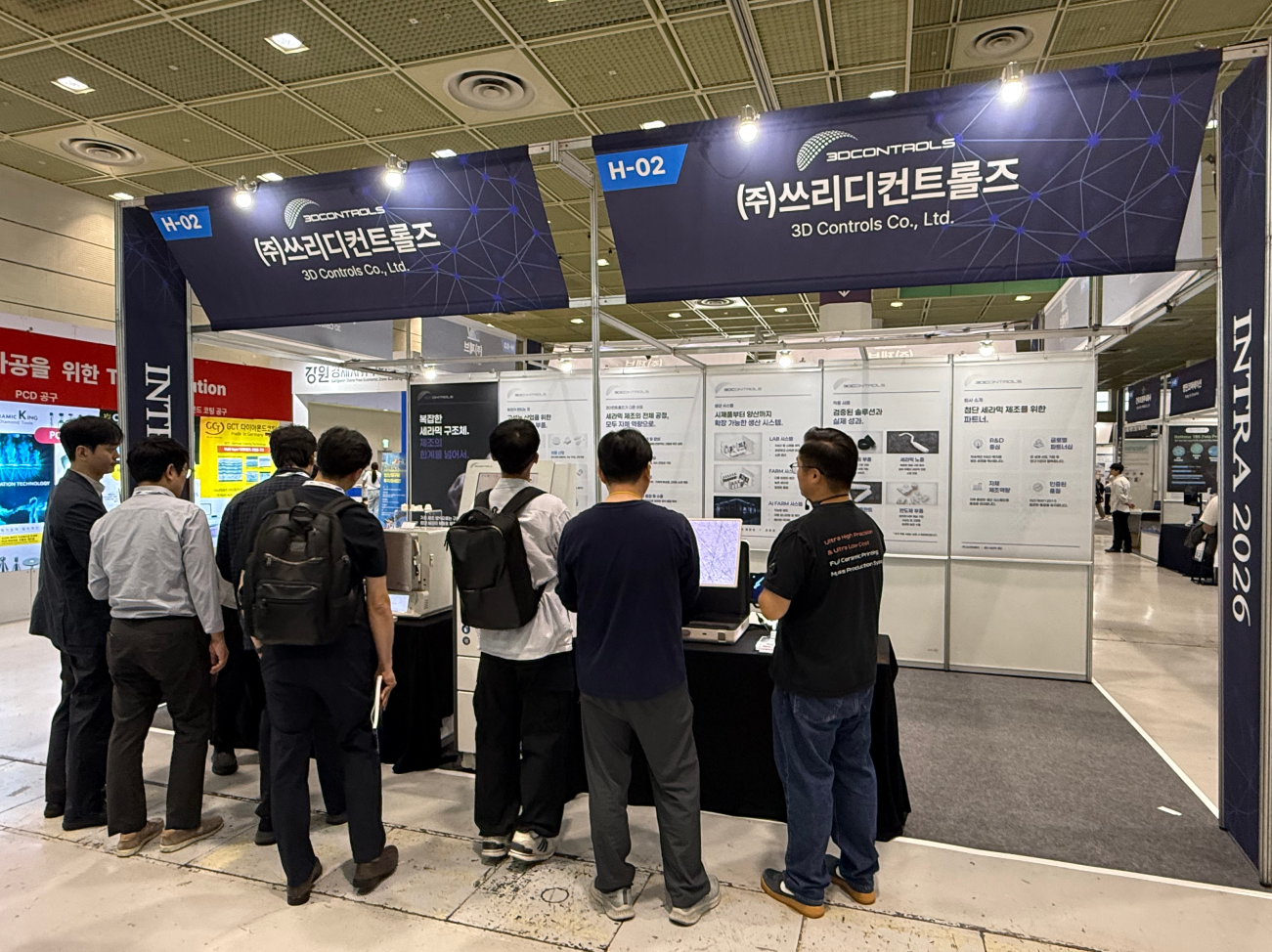
▲ Visitors are examining application examples of ceramic 3D printing in the industry at the 3D Controls booth.
3D Controls specializing in the manufacture of advanced ceramics, is expanding collaborations by introducing examples of ceramic 3D-printed parts production required for high-tech industries such as semiconductors, electronics, and automobiles.
3D Controls (CEO Lee Sang-kyu) announced on the 6th that it participated in the "14th International Advanced Materials & Technology Exhibition (INTRA 2026)," Korea's leading exhibition specializing in advanced materials, held at COEX in Seoul from September 30 to October 2.
INTRA 2026 was held in conjunction with the Fall Conference of the Korean Ceramic Society, attracting representatives from domestic and international materials and components companies, universities, research institutes, and high-tech industry demand companies interested in advanced ceramic materials and technologies.
At this exhibition, 3D Controls showed a variety of precision ceramic parts manufactured using materials such as alumina (Al₂O₃) and zirconia (ZrO₂). Notably, the company emphasized the practicality of its technology and its potential for industrial application by introducing ceramic 3D-printed parts and application examples used in actual industrial settings, such as nozzles and filters, rather than limiting itself to simple research samples or prototypes.
Ceramic 3D printing is advantageous for manufacturing parts that are difficult or costly to produce using conventional processing methods, as it allows for the realization of complex internal structures and shapes without the need for molds. Furthermore, leveraging the heat resistance, wear resistance, electrical insulation, and corrosion resistance of ceramic materials, the scope of application is expanding across various industrial sectors, including semiconductors, electrical and electronics, automobiles, and machinery.
During the exhibition, representatives from universities and government-funded research institutes, as well as companies with actual demand for ceramic parts in the semiconductor, electrical and electronics, automotive, and machinery industries, visited the booth to conduct consultations regarding the production of new parts and the potential for converting existing metal and polymer components to ceramics. An official from 3D Controls stated, “Ceramic 3D printing is now evolving beyond a mere prototyping technology for verifying shapes into a manufacturing technology that produces functional components used in actual industrial settings.” The official added, “We will continue to expand various application cases, including nozzles and filters, and broaden our business scope to become an advanced ceramic manufacturing solution company that supplies final ceramic components by proposing manufacturing processes tailored to the materials, shapes, production quantities, and performance requirements of our customers.”
Source: http://amenews.kr/news/view.php?idx=68202


3D Controls Showcases Industrial Ceramic 3D Printing Production at ‘INTRA 2026’
- Exhibition of nozzles, filters, etc., and discussions on collaboration with demand companies in semiconductor, electronics, and automotive sectors
2026-10-06
▲ Visitors are examining application examples of ceramic 3D printing in the industry at the 3D Controls booth.
3D Controls specializing in the manufacture of advanced ceramics, is expanding collaborations by introducing examples of ceramic 3D-printed parts production required for high-tech industries such as semiconductors, electronics, and automobiles.
3D Controls (CEO Lee Sang-kyu) announced on the 6th that it participated in the "14th International Advanced Materials & Technology Exhibition (INTRA 2026)," Korea's leading exhibition specializing in advanced materials, held at COEX in Seoul from September 30 to October 2.
INTRA 2026 was held in conjunction with the Fall Conference of the Korean Ceramic Society, attracting representatives from domestic and international materials and components companies, universities, research institutes, and high-tech industry demand companies interested in advanced ceramic materials and technologies.
At this exhibition, 3D Controls showed a variety of precision ceramic parts manufactured using materials such as alumina (Al₂O₃) and zirconia (ZrO₂). Notably, the company emphasized the practicality of its technology and its potential for industrial application by introducing ceramic 3D-printed parts and application examples used in actual industrial settings, such as nozzles and filters, rather than limiting itself to simple research samples or prototypes.
Ceramic 3D printing is advantageous for manufacturing parts that are difficult or costly to produce using conventional processing methods, as it allows for the realization of complex internal structures and shapes without the need for molds. Furthermore, leveraging the heat resistance, wear resistance, electrical insulation, and corrosion resistance of ceramic materials, the scope of application is expanding across various industrial sectors, including semiconductors, electrical and electronics, automobiles, and machinery.
During the exhibition, representatives from universities and government-funded research institutes, as well as companies with actual demand for ceramic parts in the semiconductor, electrical and electronics, automotive, and machinery industries, visited the booth to conduct consultations regarding the production of new parts and the potential for converting existing metal and polymer components to ceramics. An official from 3D Controls stated, “Ceramic 3D printing is now evolving beyond a mere prototyping technology for verifying shapes into a manufacturing technology that produces functional components used in actual industrial settings.” The official added, “We will continue to expand various application cases, including nozzles and filters, and broaden our business scope to become an advanced ceramic manufacturing solution company that supplies final ceramic components by proposing manufacturing processes tailored to the materials, shapes, production quantities, and performance requirements of our customers.”
Source: http://amenews.kr/news/view.php?idx=68202